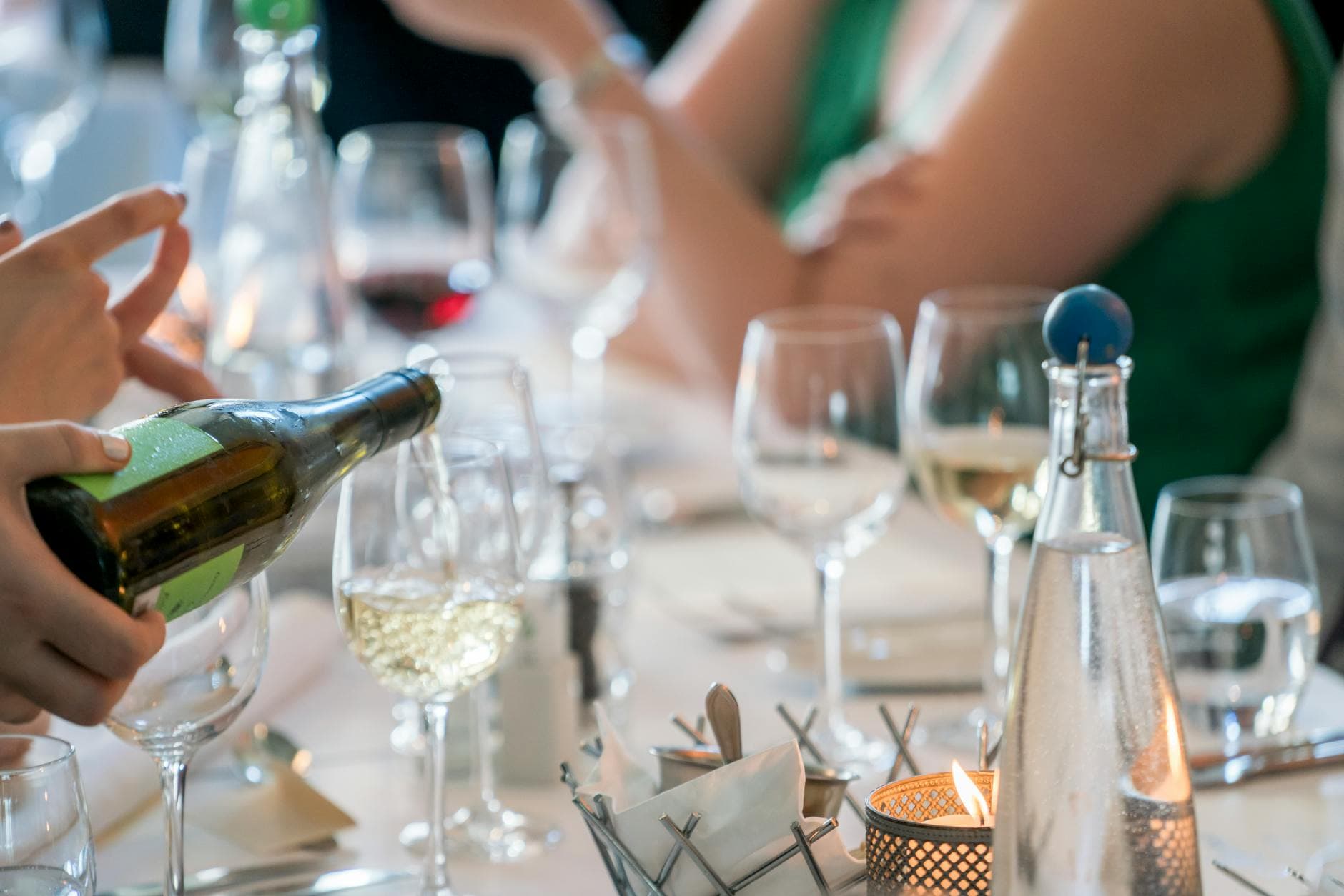
Wine for a Dinner Party: The Host's Cheat Sheet
How to plan a wine lineup for six to eight guests without overthinking it, overspending, or running out.

Plan a 3-wine arc for any dinner party: start with sparkling as the welcome pour (Gruet Brut or Cava, $10-15), serve a crowd-pleaser red with dinner (Côtes du Rhône or Malbec, $12-18), and keep a white option available (Sauvignon Blanc). Add a wild card for conversation — an orange wine, sherry, or pet-nat. Quantity math: one bottle per two guests for a 2-3 hour dinner. Decant the red when the first guest arrives, not when you sit down. Never apologize for the wine you are serving.
The three-wine arc
You do not need to be a sommelier to host well. You need a plan. Here is the plan: three wines, served in order, each with a job to do. The welcome pour, the crowd-pleaser, and the wild card. Set it up before your guests arrive and the evening runs itself.
The welcome pour — bubbles
Sparkling wine as guests arrive accomplishes three things. It signals celebration. It pairs with any appetizer you have set out. And it buys you time in the kitchen. Prosecco, Cava, Crémant, or domestic sparkling all work. This is not the moment for $80 Champagne — guests are standing, distracted, talking. Nobody is going to close their eyes and contemplate the mousse. Save the money for the dinner wine.
Gruet Brut from New Mexico ($15) is méthode champenoise and punches so far above its price point that sommeliers use it in blind tastings to embarrass Champagne snobs. Segura Viudas Brut Reserva Cava ($10) is even cheaper and perfectly solid. Pop it, pour it, move on.

The crowd-pleaser red
One red wine that offends nobody. Medium-bodied, fruit-forward, moderate tannins. You want the wine equivalent of a good host — approachable, interesting, never dominating the conversation. E. Guigal Côtes du Rhône ($14) is my default. Grenache-led, herbal, food-friendly, and impossible to dislike. Altos Las Hormigas Clásico Malbec ($12) is another — soft, ripe, works with everything from roast chicken to pasta to a cheese board.
Avoid anything too tannic (young Barolo), too funky (natural wine with barnyard notes), or too polarizing (heavy oak bombs). This is diplomacy in a glass. Save your exotic bottles for the friends who will appreciate them.
The white option
Always have a white available even if dinner is red-wine food. At least one guest will want it. Sauvignon Blanc or unoaked Chardonnay are the safest bets. Kim Crawford ($14) is the reliable play. One bottle is usually enough — it is there as insurance, not the headliner.
The wild card
This is where you show personality. One bottle that starts a conversation — an orange wine, a pét-nat, a sherry, a dessert wine for after dinner. Something your guests have not tried. Lustau Manzanilla Sherry ($15) with charcuterie is an absolute conversation starter. Broadbent Vinho Verde ($10) with its slight fizz is another. This is the bottle people remember. It does not have to be expensive. It has to be interesting.
The math
- One bottle per two guests for a 2-3 hour dinner. A bottle holds 4-5 real-world glasses (home pours average 6 ounces, not the 5-ounce standard).
- For 6 guests: 1 sparkling + 2 red + 1 white + 1 wild card = 5 bottles.
- For 8 guests: 1-2 sparkling + 2-3 red + 1-2 white + 1 wild card = 6-8 bottles.
- Heavy-pour warning: if your crowd drinks, add one more bottle. Running out is worse than having leftovers.
Temperature and timing
Open the red wine when the first guest arrives, not when you sit down to eat. It needs air. Pour yourself the first taste to confirm it is sound, then decant or let it breathe. Sparkling should come straight from the fridge — 43 to 50 degrees. Whites need 10 minutes out of the fridge before serving. Reds — and this is the move most people miss — benefit from 15 minutes in the fridge if your house is warm. You want 60-65 degrees for a full red, not 72.
Serve the lightest wine first, heaviest last. Sparkling to white to red to dessert. Your palate escalates naturally. Do not start with Cabernet and then hand someone Prosecco — everything after the big red will taste thin.
When someone brings a bottle
A bottle brought to a dinner party is a host gift. You are not obligated to open it. Thank them warmly, set it aside. If it is something great, mention you are saving it for a special evening. The only exception: if the guest specifically says it pairs with what you are cooking and you have verified this, open it. Otherwise, your lineup is your lineup. You planned it for a reason.
And one final rule: never apologize for the wine you are serving. If you say 'it is nothing special,' you have just told your guests it is nothing special. Pour with confidence. The context of good company makes any wine better.
No more last-minute wine runs. A properly stocked cellar means the right bottle for every dinner party is already waiting at perfect temperature.
Book Consultation