What Does a Custom Wine Cellar Actually Cost?
A transparent breakdown of what drives wine cellar pricing — from reach-ins to walk-in vaults.

Custom wine cellars range from $15,000 for a small reach-in to over $500,000 for large walk-in vaults with glass walls, custom millwork, and commercial cooling. The biggest cost drivers are racking material (metal vs walnut), glass enclosures, climate control, and lighting design. Most Bijou builds land between $45,000 and $180,000.
Why nobody gives you a straight answer
You have Googled this. You have gotten answers ranging from $5,000 to $500,000 and you are no closer to knowing what your cellar will cost. I get it. The range is absurd because the variables are real — a closet conversion with pine racking and a through-wall cooling unit is a fundamentally different project than a 200-square-foot walk-in with frameless Starphire glass, cable suspension racking, and a ducted split cooling system.
I am going to break this down the way I wish someone had when I started. Every number here is real. Some of them will make you comfortable. Some of them will make you reconsider. Both of those are useful outcomes.
Total project cost by cellar type
- Wine closet or reach-in: $5,000-15,000. Fits 100-300 bottles. This is a converted closet with racking, a through-wall cooling unit, and basic lighting. It is the entry point and it works.
- Under-stairs conversion: $5,000-20,000. Fits 200-400 bottles. Dead space becomes the best room in the house. We have done these with frameless glass facades that turn a staircase into a showpiece.
- Small walk-in (50-100 sq ft): $15,000-40,000. Fits 300-1,000 bottles. A dedicated room with racking on multiple walls, proper climate control, and room to stand inside and pour.
- Medium walk-in (100-200 sq ft): $40,000-75,000. Fits 1,000-2,500 bottles. This is where most serious collectors land. Room for mixed racking, a tasting counter, display lighting.
- Large custom cellar (200+ sq ft): $75,000-150,000+. Fits 2,500-5,000+ bottles. Multiple racking systems, tasting area, often glass walls, commercial-grade cooling. These are rooms people design their homes around.
- Wine tasting room with bar integration: $50,000-200,000. The cellar becomes an entertainment space. Tasting bar, seating, integrated sound, the works.
The national average for a custom wine cellar is around $33,750. Most Bijou builds land between $45,000 and $180,000 because our clients are building something they want to show off, not just something that holds bottles.
What drives the cost — racking
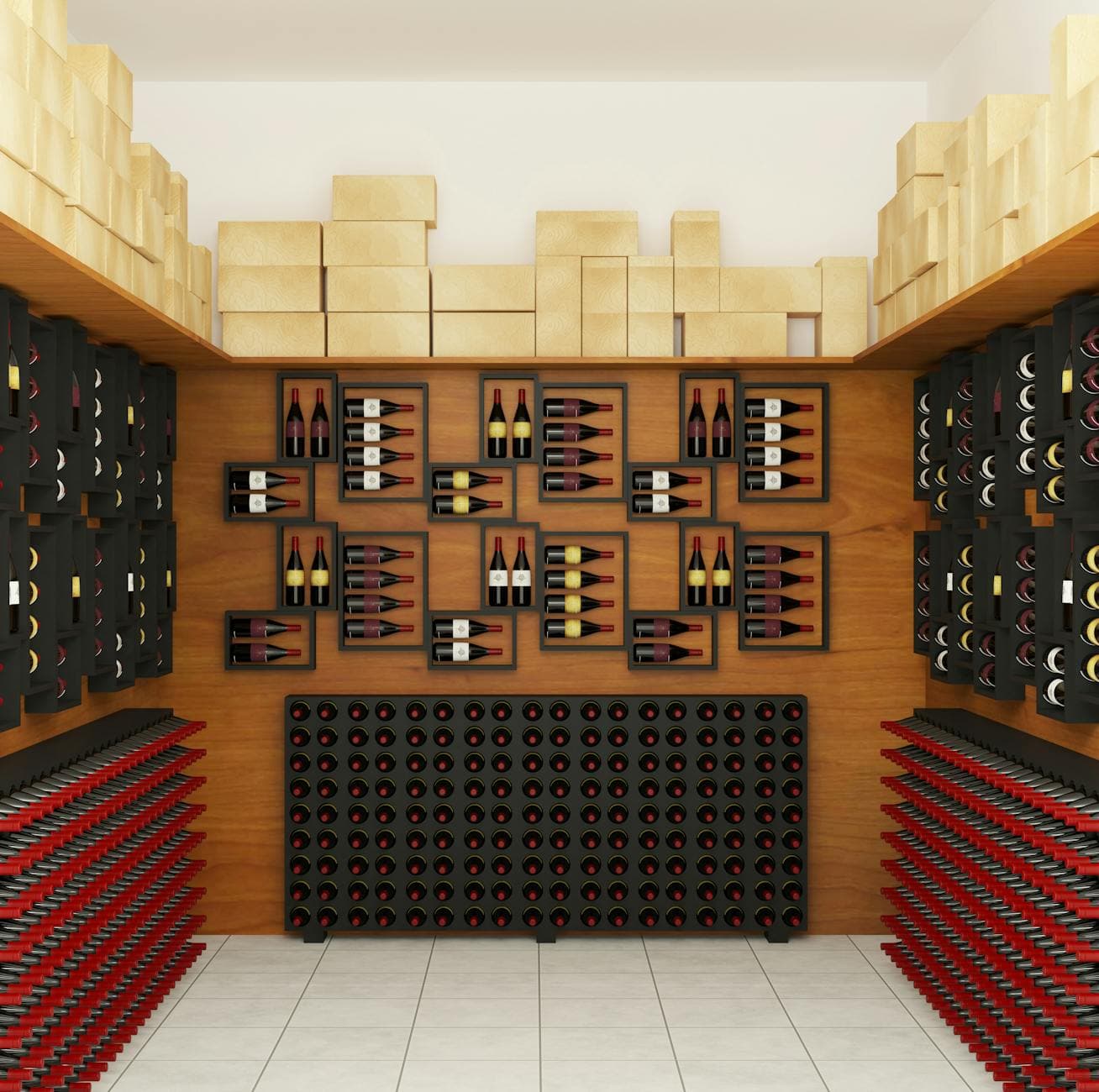
Racking is usually the largest single line item after construction, and the range is enormous depending on material and style.
- Pine modular kits: $1-15 per bottle slot. Total $3,000-10,000. These are off-the-shelf systems that you configure and install. Functional, not beautiful.
- Redwood or mahogany custom: $5-100 per bottle slot. Total $8,000-25,000. Custom millwork, stained and lacquered. This is what most people picture when they think custom cellar.
- Metal commercial racking (VintageView style): $3-25 per bottle slot. W Series wall-mount rails run about $4-12 per bottle. Evolution floor-to-ceiling is $7-13. Vino Rails cable systems are $16-21. Vino Pins peg systems are $18-23.
- Cable suspension: Premium look, label-forward presentation. $15-25 per bottle position installed. The bottles float on polished chrome cables behind frameless glass — this is the Bijou signature.
- Display shelving with LED: $15,000-30,000+ for a feature wall. This is art, not storage. The bottles are the design element.
What drives the cost — glass
Glass changes everything about a cellar — how it looks, how it performs, and what it costs. A frameless glass enclosure adds roughly 14% to total project cost. A steel-framed glass enclosure adds closer to 37%. The glass itself runs $25-75 per square foot installed.
- Frameless glass panel: ~$5,000 on a 500-bottle cellar
- Steel-framed glass enclosure: ~$16,000 on a 500-bottle cellar
- Glass doors: $1,000-5,000 each depending on size and hardware
- Starphire ultra-clear glass: 15-20% premium over standard — but the difference is visible. Standard glass has a green tint. Starphire is crystal clear.
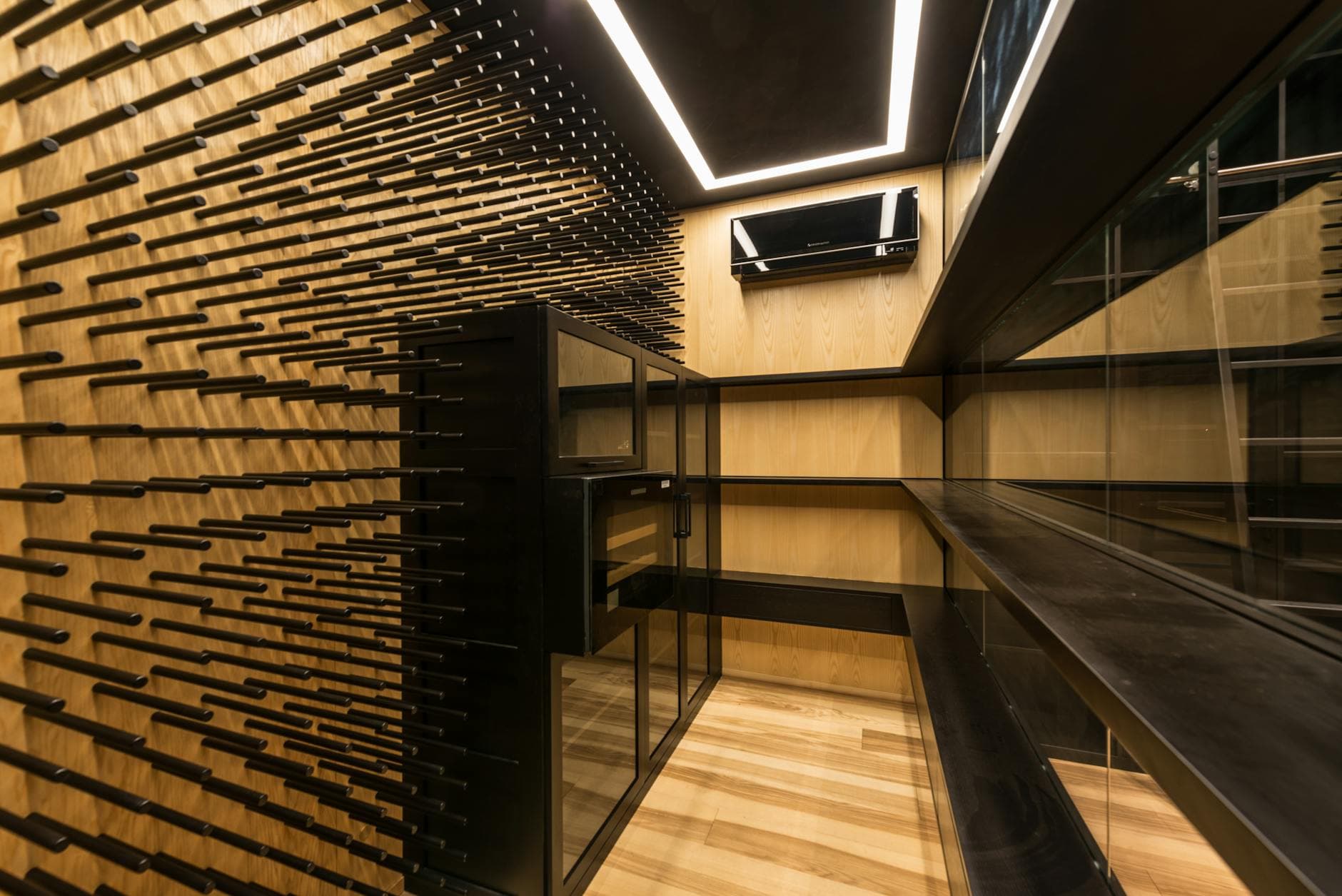
Glass also affects your cooling requirements. It is a terrible insulator. Every square foot of glass surface increases the BTU load on your cooling system, which means a larger unit, which means more cost. Beautiful and expensive are correlated here.
What drives the cost — cooling
Climate control is not optional. If you are spending money on wine worth aging, you are spending money on a cooling system. The question is how much.
- Through-wall self-contained: $1,000-4,000. Simple install, works for small cellars under 300 cubic feet. Downside: compressor noise and vibration transfer into the cellar.
- Split system (ducted): $2,500-8,000. Compressor lives remotely — garage, mechanical room, attic. Quiet, low vibration, the right choice for most residential builds.
- Fully ducted commercial: $5,000-15,000. Precise temperature and humidity control with supply and return air ducting. Required for large cellars and commercial installations.
On a typical 500-bottle active cellar, cooling represents 30-37% of total project cost. That surprises people. But the cooling system is the thing keeping $20,000-100,000 worth of wine alive. It is not where you cut corners.
The rest of the budget
- Insulation and vapor barrier: $1,500-5,000. Closed-cell spray foam ($1,500-4,000), vapor barrier ($500-1,500), insulated door ($500-2,000). Non-negotiable — without proper insulation, your cooling system fights a losing battle.
- Doors: Wood ($500-3,000), steel ($600-4,000), glass ($1,000-5,000), wrought iron ($2,000-6,000).
- Flooring: Natural stone, tile, or engineered hardwood. $1,000-5,000 depending on material and square footage.
- Lighting: Recessed LED, track lighting, backlit panels. $500-5,000. Good lighting is the difference between a storage room and a showroom.
- Tasting bar or counter: $3,000-15,000. Optional but transformative. It turns storage into a destination.
What a real budget looks like
Here is a real-world example. A 100-square-foot walk-in cellar for 1,200 bottles with cable suspension racking, frameless Starphire glass, split cooling, LED track lighting, natural stone floor, and a small tasting shelf. Total: $85,000-110,000. That is a Bijou build. That is a room that makes people stop in the hallway and stare.
Now here is the same room with pine modular racking, no glass, a through-wall cooling unit, and basic recessed lighting. Total: $18,000-25,000. It stores the same wine at the same temperature. It just does not make anyone stop and stare.
Neither is wrong. But they are different projects with different goals, and the honest answer to what does a cellar cost is: it depends on which of those two rooms you want to walk into every evening.
Every Bijou consultation starts with your space, your collection, and your vision. We will give you a transparent estimate — no surprises, no hidden line items.
Book Consultation