Glass Wine Walls vs. Traditional Cellars: How to Decide in 2026
Glass walls are exploding in luxury residential. Cellars are still quietly winning the long game. Here's the honest trade-off.

Glass wine walls work best when the collection is part of the living space. Visible, architectural, integrated with the room. Traditional cellars win when storage volume, long-term aging, and climate precision matter more than display. The right answer depends on how you drink and how long you plan to hold what you buy.
The short answer, if you hate hedging
If you entertain often, drink most of what you buy within three years, and want the collection to be a visible part of the house. Build a glass wall. If you collect investment bottles you plan to hold for a decade, build a real cellar. Most of our clients at the top of the market end up building both.
What a glass wine wall actually is
A glass wine wall is a climate-controlled display enclosure built with frameless or minimally framed tempered glass, backed by custom metal or wood racking. The glass isn't decorative. It is structural to the climate envelope. A proper wall uses sealed glass units (the same technology as high-end exterior windows) to isolate the temperature inside from the room outside. Without that engineering, you are stacking bottles in a refrigerator with a window.
Bottle count depends on height and depth. A single-bottle-deep wall 8 feet wide and 9 feet tall holds roughly 180 bottles. Go double-depth and you are at 360. Triple the length and you are in serious collector territory. 900 to 1,200 bottles of visible, drinking-ready storage, without losing a closet.
What a traditional cellar actually is
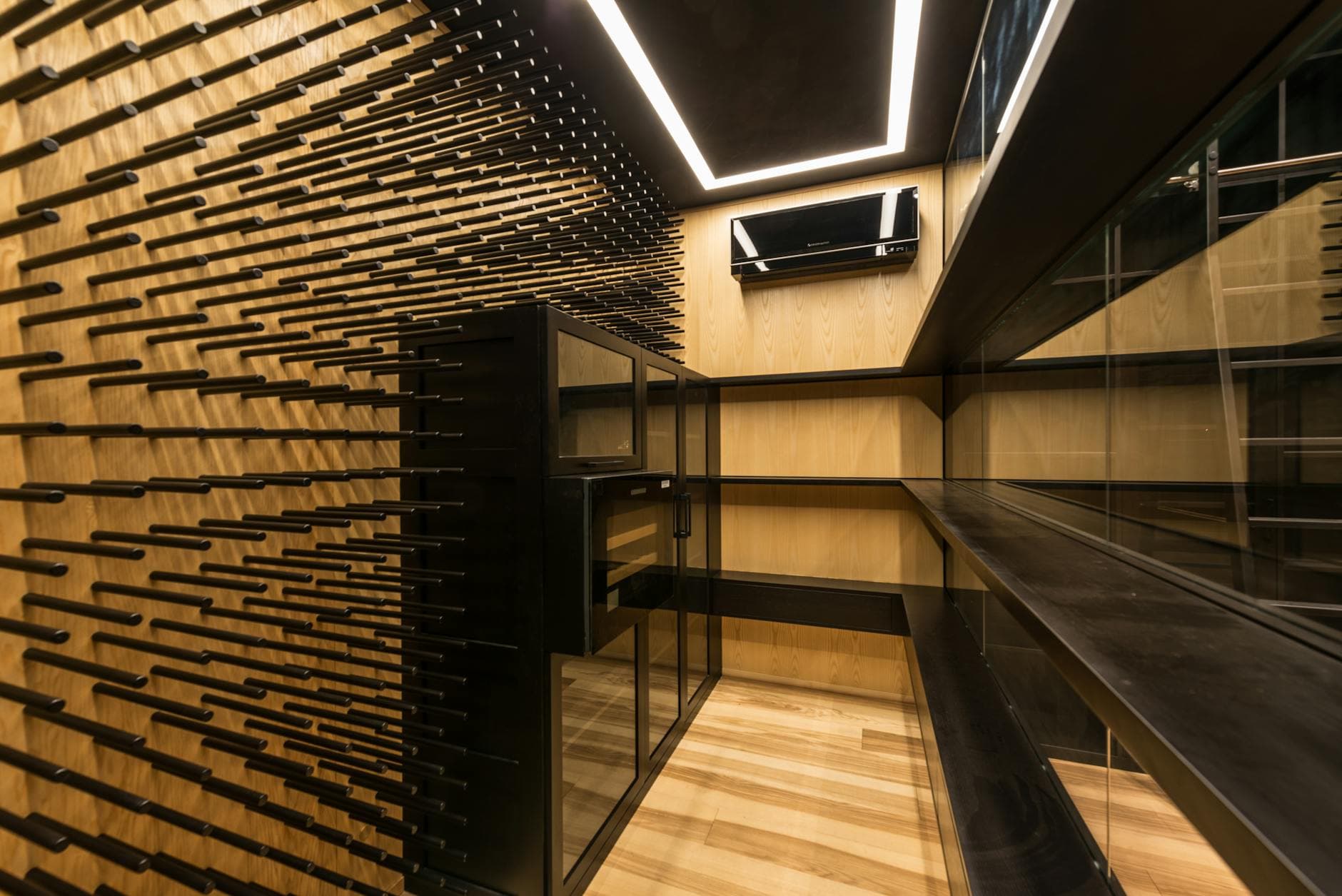
A traditional cellar is an enclosed room dedicated to storage, built with insulated walls, a vapor barrier, a dedicated cooling unit, and racking designed for long-term aging. The best traditional cellars are passive. Meaning they borrow thermal mass from below-grade walls and barely need to run a compressor. The next best are active walk-ins with commercial cooling engineered for a 20-year service life.
Walk-in cellars run anywhere from 400 bottles in a small closet conversion to 3,000+ in a full vault. Below 400 bottles, you are usually better off with a reach-in or a climate cabinet. Above 3,000, you start needing dedicated HVAC design and structural engineering. That is where the real cellar-builder trade earns its fee.

The honest trade-offs
Display vs. storage volume
A wall shows the collection. A cellar stores it. You cannot do both well in the same square footage. A 40-square-foot closet gets you either a stunning 300-bottle glass wall in the kitchen or a 1,200-bottle walk-in you have to open a door to see. The question is whether you want bottles to be furniture or archives.
Climate precision
Traditional cellars hit tighter climate specs more easily. You are working with six insulated surfaces instead of one large glass panel that gains and loses heat every time the sun moves. Walls can be engineered to match. We do it all the time. But you will spend more on glass tech, gaskets, and cooling to get there. If you are aging grand cru Burgundy for 20 years, the cellar is the safer build. For more on that, see our guide on how to store wine at home.
Cost drivers
A glass wine wall typically runs $800 to $1,500 per linear foot depending on glass specification, door hardware, racking material, and integrated lighting. A walk-in cellar typically runs $300 to $800 per square foot depending on cooling system, racking, and finish work. On a per-bottle basis, walk-ins are almost always cheaper. On a per-impression basis, walls win. For a transparent breakdown of what drives cellar pricing across every format, read our wine cellar cost breakdown.
Resale and architectural value
In the Austin, Orange County, and Houston markets we serve, glass wine walls now show up in roughly four out of five luxury listings above $3M. Appraisers increasingly treat them as permanent fixtures rather than decorative additions. A well-built wall adds comp value; a wine fridge in a closet usually does not.
How to actually decide in five minutes
- Do you drink most of what you buy within 2–3 years? → Wall.
- Are you aging bottles 10+ years? → Cellar.
- Is the primary audience you, or is it guests? → Guests means wall. You means cellar.
- Is the space in a primary living room, kitchen, or hallway? → Wall.
- Is it a basement, closet, or dedicated room? → Cellar.
- Do you own more than 800 bottles today? → Cellar first, then a wall as a secondary show space.
Why most of our best clients build both
The honest pattern at the top of the market: a dedicated traditional cellar for long-term holds and investment-grade bottles, plus a glass wine wall somewhere prominent. Usually off the kitchen or dining room. As the drinking collection and the conversation piece. The wall gets restocked monthly from the cellar, and nobody who visits the house forgets where they are.
If the budget only fits one, start with what matches how you actually drink today, not what you think you will grow into. A 200-bottle wall you use hard is worth more than a 1,500-bottle cellar you never fill.
Upload a photo of your space and the Bijou Design Studio renders a photorealistic wall or cellar inside it. With bottle count, material selections, and a proposal-ready summary.
Launch Design Studio